

ENT Procedures

Ear correction (Pinnaplasty)
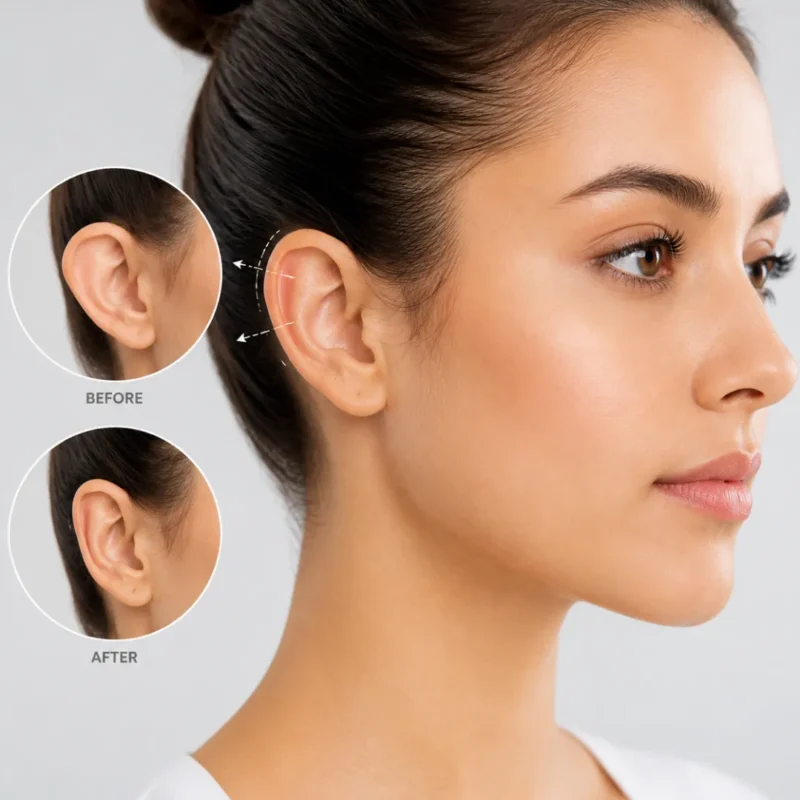
Prominent ears occur when the ear stands further away from the head than usual, often due to underdevelopment of the natural fold in the outer ear (the antihelical fold) or a deeper than usual ear bowl (concha). This can affect one or both ears, and is often, though not always, symmetrical.
Prominent ears are usually present from birth and can have a real effect on confidence and self-esteem, from childhood through to adulthood. Many people find themselves avoiding certain hairstyles or feeling self-conscious in social situations because of how their ears look.
Pinnaplasty reshapes the ear to sit closer to the head and creates a more natural fold, addressing prominence, asymmetry, or unusual shape of the upper ear or earlobe. At consultation, Mr Ranganathan discusses what’s bothering you most about the shape of your ears and what you’d like to achieve, before agreeing a surgical plan tailored to your anatomy.
Mr Ranganathan also co-runs a dedicated congenital ear anomaly service at Royal Manchester Children’s Hospital as part of his NHS practice, one of a small number of centres in the UK offering this service, including microtia reconstructive surgery for children born without a fully formed ear.
Ear correction (Pinnaplasty)
Prominent ears occur when the ear stands further away from the head than usual, often due to underdevelopment of the natural fold in the outer ear (the antihelical fold) or a deeper than usual ear bowl (concha). This can affect one or both ears, and is often, though not always, symmetrical.
Prominent ears are usually present from birth and can have a real effect on confidence and self-esteem, from childhood through to adulthood. Many people find themselves avoiding certain hairstyles or feeling self-conscious in social situations because of how their ears look.
Pinnaplasty reshapes the ear to sit closer to the head and creates a more natural fold, addressing prominence, asymmetry, or unusual shape of the upper ear or earlobe. At consultation, Mr Ranganathan discusses what’s bothering you most about the shape of your ears and what you’d like to achieve, before agreeing a surgical plan tailored to your anatomy.
Mr Ranganathan also co-runs a dedicated congenital ear anomaly service at Royal Manchester Children’s Hospital as part of his NHS practice, one of a small number of centres in the UK offering this service, including microtia reconstructive surgery for children born without a fully formed ear.

Sinusitis

Chronic rhinosinusitis is a long-term inflammation of the lining of the nose and sinuses, and can occur with or without nasal polyps. It typically causes nasal blockage, facial pain or pressure, and a reduced sense of smell.
Initial management is medical, usually involving nasal sprays, saline rinses, and other medication to reduce inflammation. Where symptoms don’t improve with medical treatment, surgical management may be recommended, most commonly endoscopic sinus surgery, using image-guided navigation where necessary for precision and safety in more complex cases.

Septal perforation repair

A septal perforation is a hole in the wall between the two nostrils, which can cause nasal obstruction, a whistling noise on breathing, crusting, and bleeding. It can result from previous surgery, trauma, or substance use.
Management depends on the size and site of the perforation, and Mr Ranganathan will advise on the most suitable option for each patient. Smaller or asymptomatic perforations may be managed conservatively. Where surgery is appropriate, this can be carried out through an open approach, using rhinoplasty techniques to close the defect, or through an endoscopic approach that closes the perforation by mobilising the mucosal flaps surrounding it.
Turbinoplasty
The turbinates are structures inside the nose that can become enlarged due to chronic rhinitis, sinusitis, or allergic rhinitis, leading to nasal obstruction and difficulty breathing. Initial management is usually medical. Where symptoms don't improve with medical treatment, turbinoplasty may be recommended to reduce the size of the turbinates and improve airflow. A range of techniques are available, including coblation, microdebrider reduction, and partial excision, with the approach chosen depending on the size and nature of the enlargement.

Allergic rhinitis

Allergic rhinitis is a very common condition, causing sneezing, congestion, itching, and a runny or blocked nose in response to allergens such as pollen, dust, or pet dander.
Blood testing can help confirm the specific allergen responsible for symptoms. Initial management is medical, using antihistamines and nasal sprays to control symptoms. For patients with persistent or severe symptoms, allergen desensitisation may be considered. Where nasal blockage doesn’t improve with medical treatment, turbinoplasty may be recommended to improve breathing.

Skin cancer

Skin cancer of the nose and surrounding facial skin is common, particularly in older adults, and is most often caused by long-term sun exposure. The nose is one of the most frequently affected sites on the face due to its prominent, sun-exposed position.
The most common types affecting the nose are basal cell carcinoma (BCC) and squamous cell carcinoma (SCC). A biopsy may be needed to confirm the diagnosis before treatment is planned.
Mr Ranganathan works closely with experienced dermatologists, including Mohs surgeons where required, in the management of skin cancer affecting the nose, and reconstructs the resulting defect once the cancer has been fully removed. (See Nasal Reconstruction for more detail.)
Scar revision
Scar revision improves the appearance of scars resulting from previous surgery, trauma, or skin cancer removal, using a range of techniques suited to the scar's size, location, and cause.
Mr Ranganathan will recommend the most appropriate technique for your individual anatomy and goals at consultation.

Frequently Asked Questions

Candidates typically include individuals who are unhappy with the appearance, prominence, or shape of their ears.

Incisions are usually hidden behind the ears, making scars minimally visible.

Yes. Ear Correction is suitable for both adults and children.

Yes. Our surgeons focus on achieving natural-looking and balanced results.

Yes. The procedure can significantly improve ear symmetry.

Most patients experience only mild discomfort during recovery, which is manageable with prescribed medication.

Book Your Consultation Book Your Consultation

Make an appointment Now!

Consultant ENT Surgeon, Rhinologist and Facial Plastic Surgeon

FRCS (ORL-HNS), MCh, EBEC-FPRS

Get Clarification Get Clarification

Ask Mr Bas Ranganathan